Monday, 29 April 2013

Representation


old or young woman?


Understanding representation is all about understanding the choices that are made when it comes to portraying something or someone in a mass media text. It's impossible to portray every aspect of an individual in a photograph, or even in a feature film, so certain features of their personality and appearance get highlighted, and are often enhanced, when it comes to constructing the representation that the audience will see. When representing a person, media texts often focus on their:
  • Age
  • Gender
  • Race/Ethnicity
  • Financial Status
  • Job
  • Culture/nationality
Signs and symbols are used as a kind of visual shorthand to represent these attributes. When we decode these signs we make assumptions about who the character is (usually by comparing them to similar characters we have encountered before), and this allows us to put them in a category and "read" them in context. For instance, when constructing characters for a TV or movie scene the producers might give an old man white hair and a walking stick, or provide a wealthy lawyer with a three piece suit to wear and a briefcase to carry. Whilst not all old men need a walking stick and not all lawyers carry briefcases, these are easy and quick ways of signifying information about the character.

Who? What? Why? Where?

When you're analysing representation, think about the following questions:
  • Who or what is being represented? Who is the preferred audience for this representation?
  • What are they doing? Is their activity presented as typical, or atypical? Are they conforming to genre expectations or other conventions?
  • Why are they present? What purpose do they serve? What are they communicating by their presence? What's the preferred reading?
  • Where are they? How are they framed? Are they represented as natural or artificial? What surrounds them? What is in the foreground and what is in the background?
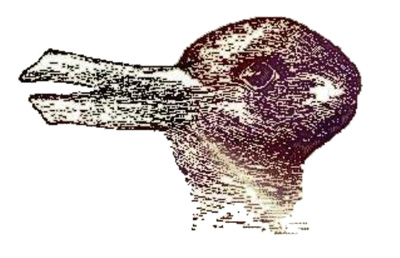
Once you start to think carefully about different representations, you will find that the same representation means different things to different people. We all decode representations according to our own life experience, where we've lived, how old we are, and what other media texts we are familiar with, as well as a myriad psychological factors. Other elements such as political sympathies and social class can come into play. When producers construct a media representation, they often assume that the audience is one homogenous mass that will all decode the representation in the same way. However, people see even the most basic images in different ways. Look at the two famous optical illusions below. What do you see first?

Duck or rabbit
Old or young woman? Duck or rabbit? The problem with representing any kind of reality in a media text is that it's never going to be 100% accurate. Representation always involves the construction of a version of reality, not reality itself (even in so-called Reality TV!) So media producers have to make choices; what to put in, what to leave out. If something is always represented the same way (our lawyer with a briefcase) we become comfortable with that representation, whether it reflects what is true about 21st century lawyers (who are more likely to be carrying a laptop bag) or not. Don't forget that every media representation represents somebody's point of view.

A Picture is Worth A Thousand Words...

Producers of media texts know that visual representation is a very powerful tool when it comes to persuading your audience what to think about a topic. Look at these two different representations of the actress Lindsay Lohan, both taken from news stories about the actress.
Lindsay LohanLindsay Lohan
Same human being, different representation. What choices have been made about framing, lighting, make up, cropping, costume in each case? Can you guess what kind of news story each image is from? What does each image make you think about Lindsay? How do you think these very different representations affect her image as a star? Do you think either one of these images is the 'real' Lindsay?

Language - Basic Media Terminology

AnchorageFixing of meaning
eg the copy text anchors (ie fixes to one spot) the meaning of an image (for instance, a single rose, that could be used for an ad for anything from a dating agency to a funeral home) in a print advertisement
AntagonistThe character whose function in a plot is to oppose the protagonist. In straightforward hero's journey plots (most action adventures), the antagonist can be referred to as the villain. However, in character drama, the antagonist might not be a "bad" character, just someone who stands between the protagonist and his/her goals.
ArchetypeA universal type or model of character that is found in many different texts, e.g. ingenue, anti-hero, wise old woman, hero-as-lover, hero-as-warrior, shadow trickster, mentor, loyal friend, temptress
AudienceThe recipients of a media text, or the people who are intended to read or watch or play or listen to it. A great deal of media studies work is concerned with the effects a text may have on an audience.
Binary OppositionThe contrast between two mutually exclusive concepts or things that creates conflict and drives a narrative e.g. good/evil, day/night, male/female, presence/absence, old/young
CensorshipControl over the content of a media text. Different media forms have different forms of censorship - sometimes from a government, but mainly from a regulatory agency, eg the British Board of Film Classification
CGIComputer Generated Imagery. Refers to the (usually) 3-D effects that enhance all kinds of still and moving images, from text effects, to digital snow or fire, to the generation of entire landscapes.
CodeA system of signs which can be decoded to create meaning.
In media texts, we look at a range of different signs that can be loosely grouped into the following:
  • technical codes - all to do with the way a text is technically constructed - camera angles, framing, typography etc
  • verbal codes - everything to do with language -either written or spoken
  • symbolic codes - codes that can be decoded on a mainly connotational level - all the things which draw upon our experience and understanding of other media texts, our cultural frame of reference.
ConnotationWay in which meaning is created —
  • Connote = meaning by association, the deeper meaning (e.g. red connotes anger, passion, love, danger)
ConventionThe widely recognised way of doing something - this has to do with content, style and form
eg the conventions of music video
  • they are the same length as the song (somewhere around 4 minutes, say)
  • they present the band, who look as though they are singing
  • they have lots of fast edits
ConvergenceThe way in which technologies and institutions come together in order to create something new. Cinema is the result of the convergence of photography, moving pictures (the kinetoscope, zoetrope etc), and sound. The iPad represents the convergence of books, TV, maps, the internet and the mobile phone.
DemographicFactual characteristics of a population sample, e.g. age, gender, race, nationality, income, disability, education.
DenotationWay in which meaning is created —
  • Denote = literal or surface meaning e.g. red is the colour of a flower
EditorialIn a newspaper, Editorial refers to the opinion pieces (sometimes known as 'leading articles') written by senior reporters. Editorial in a magazine refers to the feature content that reflects the ethos of the publication
EnigmaA question that is not immediately answered and thus draws an audience into a text
eg. a body is discovered at the beginning of a tv detective drama. The killer's identity is an enigma. We watch to find out who the killer is.
GatekeepingQuite an old-fashioned term to describe the way in which certain key personnel (news editors, newspaper owners mainly) have control over the information that is presented to audiences, and the way in which it is presented (the angle)
GenreA way of categorising a media text according to its form, style and content. This categorisation is useful for producers (who can utilise a genre's conventions) and audiences (who can utilise their expectations of the genre) alike
GlobalisationProcess by which different cultures worldwide have come to share the same media texts e.g. movies and pop music.
IdeologyThis is a complex concept - in its basic form it is a set of ideas or beliefs which are held to be acceptable by the creators of a media text. For example, a text might be described as having a feminist ideology, meaning it promotes the idea that women are the equal of men and should not be discriminated against on the grounds of gender.
InstitutionA formal organization (with its own set of rules and behaviours) that creates and distributes media texts
IntertextualityThe influence that media texts have on each other. Sometimes this is the result of direct cross-references (e.g. music mash ups) or indirect (the way gossip news items regulate the way we view a star's performance)
NarrativeThe way in which a story, or sequence of events, is put together within a text. All media texts have some sort of narrative, from a single photographic image to a sports report to a feature film.
Narrative may be reduced to one simple equation which is
equilibrium - disequilibrium - new equilibrium
NeologismNewly-coined word or phrase made up to describe a new trend, idea or gadget e.g. hopium, agnotology
News ValuesWays of categorising and assessing news stories to decide on their newsworthiness
OwnershipAn important issue in media studies - and a constantly changing one. Who produces and distributes the media texts we read?
POV (Point of View)A first-person camera shot that shows a scene from an individual character's viewpoint. Used to help the audience understand what is happening in a character's head e.g. a predator stalking his/her prey
Preferred ReadingThe meaning of a text which the producers intended. The opposite of 'preferred reading' is 'aberrant reading', such as when people deliberately interpret a text (the Bible is the source of a lot of mixed messages) to further their political agenda rather than the author's original intent
ProtagonistThe character who drives the narrative forward, through the choices they make and the actions they take
RealismThe techniques by which a media text represents ideas and images that are held to have a true relationship with the actual world around us. Realism means different things in different texts - realism in animation (eg the movement of single hairs in computer animation) means something entirely different to realism in soap opera (eg the depiction of people eating breakfast and talking with their mouths full). it is important to assess how much a text strives for realism, how much audiences are expected to think it is realistic.
RepresentationThe way in which the media "re-presents" the world around us in the form of signs and codes for audiences to read.
Self-RegulationWhen an institution (the Press, Advertising) appoints a group of individuals whose job is to deal with complaints about that institution
Signs & SignificationSign - a symbol which is understood to refer to something other than itself. This may be very simple - think of a "No Entry" road sign. it may get more complicated when reading media texts, where a sign might be the bright red coat that a character is wearing (which signals that they are dangerous)
Signification - the process of reading signs (see denotation and connotation)
StarA person who has become so famous, both for doing their job (actor, sport player) and appearing in many sorts of media, that their image is instantly recognisable as a sign, with a whole range of meanings or significations
eg - David Beckham's image represents a whole raft of meanings: England, football, wealth, Posh, success, fashion victim, expertise, sexuality etc...
Britney Spears is also a star but her image signifies physical fitness, blonde (+associated stereotypical characteristics), singing, dancing, sexuality, fashion etc...
A star's image becomes a readily recognised sign that is used in many different media forms - think of where you have seen pictures of Britney and Becks. Stars can use the fact that their image has meaning by allowing it to be used for advertising purposes.
StereotypeStereotypes are negative (usually) representations of people that rely on preconceived ideas about the group that person is perceived as belonging to. It is assumed that an individual shares personal characteristics with other members of that group eg blondes are all stupid, accountants are all boring.
Although using stereotypes saves a lot of explanation within a text, it can be a very lazy method of characterisation. Stereotypes may be considered dangerous, as they encourage audiences to think large groups of people are all the same, and often have the same negative characteristics.
USPUnique Selling Point or Proposition. The attribute of a text or product that is highlighted as being new or unique in the marketing process, something that sets it apart from its competitors

Genre - You Tube Revision - Action Adventure Films

Below are a number of you tube videos to revise the action adventure genre.

Action Adventure Genre and Sub-Genres

Conventions of Action Adventure Movies

50 Action Adventure Films You Must See Before You Die


Exam Papers and Mark Schemes


It is essential that when you go into the exam you are familiar with the exam paper format and know how long you want to spend on each section.  Below are the links to the past papers and mark schemes for those papers for your exam.  Your exam board is OCR and there are a number of resources you can find to help you on the site.

Past Paper Summer 2012

Past Paper Summer 2011

Top Action Adventure Movies


Just some sites to get you started.  Enjoy


Top 100 Action Adventure Movies can be found here.

Guardian film section of the paper can be found here.